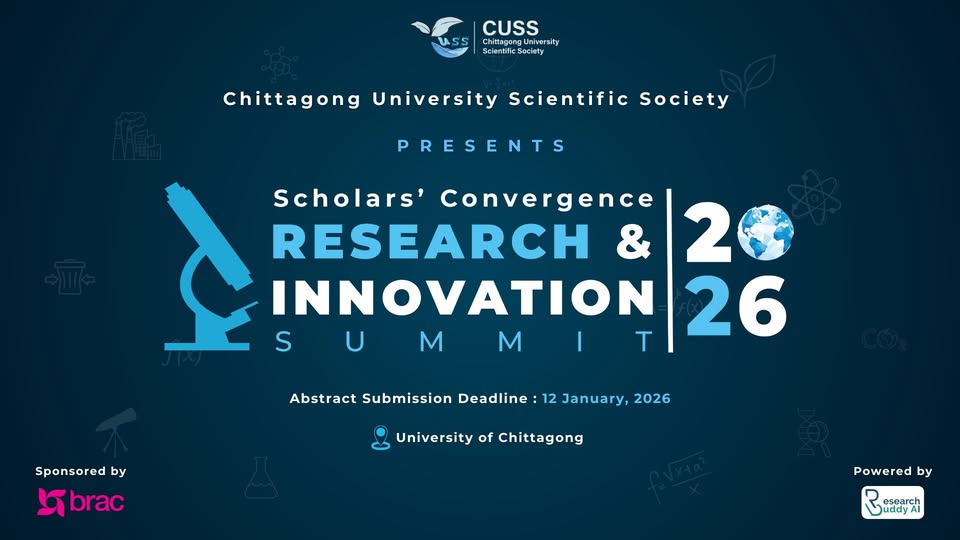
𝐒𝐜𝐡𝐨𝐥𝐚𝐫𝐬' 𝐂𝐨𝐧𝐯𝐞𝐫𝐠𝐞𝐧𝐜𝐞: 𝐑𝐞𝐬𝐞𝐚𝐫𝐜𝐡 𝐚𝐧𝐝 𝐈𝐧𝐧𝐨𝐯𝐚𝐭𝐢𝐨𝐧 𝐒𝐮𝐦𝐦𝐢𝐭 𝟐𝟎𝟐𝟔
𝐂𝐡𝐢𝐭𝐭𝐚𝐠𝐨𝐧𝐠 𝐔𝐧𝐢𝐯𝐞𝐫𝐬𝐢𝐭𝐲 𝐒𝐜𝐢𝐞𝐧𝐭𝐢𝐟𝐢𝐜 𝐒𝐨𝐜𝐢𝐞𝐭𝐲 (𝐂𝐔𝐒𝐒) is vastly excited to announce "𝐒𝐜𝐡𝐨𝐥𝐚𝐫𝐬' 𝐂𝐨𝐧𝐯𝐞𝐫𝐠𝐞𝐧𝐜𝐞: 𝐑𝐞𝐬𝐞𝐚𝐫𝐜𝐡 𝐚𝐧𝐝 𝐈𝐧𝐧𝐨𝐯𝐚𝐭𝐢𝐨𝐧 𝐒𝐮𝐦𝐦𝐢𝐭 𝟐𝟎𝟐𝟔", 𝐏𝐨𝐰𝐞𝐫𝐞𝐝 𝐛𝐲 𝐑𝐞𝐬𝐞𝐚𝐫𝐜𝐡𝐁𝐮𝐝𝐝𝐲 𝐀𝐈. This research summit is designed to bring together students, researchers, academicians, and innovators under one roof.
Research is an intellectual pursuit that goes beyond the experiment and the research paper. Research is driven by curiosity, and the courage to ask those hard questions and make those hard decisions. The attendees of Scholars Convergence 2026 are given a unique opportunity to work in an exciting environment to share knowledge and develop the ability to create impact in the real world with their ideas.
Scholars Convergence 2026 will encourage all attendees, regardless of discipline to collaborate and share ideas related to all disciplines.
Two main segments of the Research Summit:
𝐎𝐫𝐚𝐥 𝐏𝐫𝐞𝐬𝐞𝐧𝐭𝐚𝐭𝐢𝐨𝐧
𝐏𝐨𝐬𝐭𝐞𝐫 𝐏𝐫𝐞𝐬𝐞𝐧𝐭𝐚𝐭𝐢𝐨𝐧
Themes of the Summit:
𝐏𝐡𝐲𝐬𝐢𝐜𝐚𝐥 𝐚𝐧𝐝 𝐂𝐡𝐞𝐦𝐢𝐜𝐚𝐥 𝐒𝐜𝐢𝐞𝐧𝐜𝐞𝐬: (𝐏𝐡𝐲𝐬𝐢𝐜𝐬, 𝐂𝐡𝐞𝐦𝐢𝐬𝐭𝐫𝐲, 𝐌𝐚𝐭𝐡𝐞𝐦𝐚𝐭𝐢𝐜𝐬, 𝐒𝐭𝐚𝐭𝐢𝐬𝐭𝐢𝐜𝐬, 𝐌𝐚𝐭𝐞𝐫𝐢𝐚𝐥𝐬 𝐒𝐜𝐢𝐞𝐧𝐜𝐞, 𝐒𝐩𝐚𝐜𝐞 𝐒𝐜𝐢𝐞𝐧𝐜𝐞)
This theme encompasses fundamental and applied research that advances our understanding of physical laws, chemical processes, and mathematical principles governing natural and engineered systems. It welcomes theoretical, experimental, and computational studies, including research on mathematical modeling, statistical analysis, materials development, and space or astrophysical sciences. Interdisciplinary research with technological relevance or potential societal and industrial applications is especially encouraged.
𝐋𝐢𝐟𝐞 𝐚𝐧𝐝 𝐇𝐞𝐚𝐥𝐭𝐡 𝐒𝐜𝐢𝐞𝐧𝐜𝐞𝐬: (𝐁𝐢𝐨𝐥𝐨𝐠𝐲, 𝐁𝐢𝐨𝐭𝐞𝐜𝐡𝐧𝐨𝐥𝐨𝐠𝐲, 𝐌𝐞𝐝𝐢𝐜𝐚𝐥 & 𝐀𝐠𝐫𝐢𝐜𝐮𝐥𝐭𝐮𝐫𝐚𝐥 𝐒𝐜𝐢𝐞𝐧𝐜𝐞𝐬)
This theme focuses on biological systems, human health, and life-science innovations that contribute to improved quality of life and sustainable development. It includes research in molecular and cellular biology, microbiology, biotechnology, biomedical and medical sciences, public health, agriculture, and food systems. Studies addressing disease mechanisms, diagnostics, therapeutics, environmental health, and sustainable agricultural practices are highly encouraged, particularly those with translational or societal impact.
𝐄𝐧𝐠𝐢𝐧𝐞𝐞𝐫𝐢𝐧𝐠, 𝐓𝐞𝐜𝐡𝐧𝐨𝐥𝐨𝐠𝐲 & 𝐃𝐚𝐭𝐚 𝐒𝐜𝐢𝐞𝐧𝐜𝐞𝐬: (𝐀𝐫𝐭𝐢𝐟𝐢𝐜𝐢𝐚𝐥 𝐈𝐧𝐭𝐞𝐥𝐥𝐢𝐠𝐞𝐧𝐜𝐞, 𝐃𝐚𝐭𝐚 𝐒𝐜𝐢𝐞𝐧𝐜𝐞, 𝐑𝐨𝐛𝐨𝐭𝐢𝐜𝐬 & 𝐀𝐩𝐩𝐥𝐢𝐞𝐝 𝐓𝐞𝐜𝐡𝐧𝐨𝐥𝐨𝐠𝐲)
This theme highlights cutting-edge research and innovations driving digital transformation and technological advancement. It covers artificial intelligence, machine learning, data analytics, robotics, automation, smart systems, and applied engineering solutions. Contributions may focus on system design, optimization, modeling, software and hardware development, or real-world applications across healthcare, industry, environment, and smart infrastructure. Interdisciplinary and data-driven approaches are strongly encouraged.
𝐄𝐚𝐫𝐭𝐡, 𝐄𝐧𝐯𝐢𝐫𝐨𝐧𝐦𝐞𝐧𝐭𝐚𝐥 & 𝐒𝐮𝐬𝐭𝐚𝐢𝐧𝐚𝐛𝐢𝐥𝐢𝐭𝐲 𝐒𝐜𝐢𝐞𝐧𝐜𝐞𝐬: (𝐂𝐥𝐢𝐦𝐚𝐭𝐞, 𝐌𝐚𝐫𝐢𝐧𝐞, 𝐄𝐧𝐯𝐢𝐫𝐨𝐧𝐦𝐞𝐧𝐭𝐚𝐥 & 𝐑𝐞𝐧𝐞𝐰𝐚𝐛𝐥𝐞 𝐒𝐭𝐮𝐝𝐢𝐞𝐬)
This theme addresses research on Earth systems, environmental dynamics, and sustainable solutions to global and regional challenges. It includes studies on climate change, marine and coastal sciences, geology, environmental monitoring, biodiversity conservation, renewable energy, and sustainable resource management. Research supporting climate resilience, ecosystem protection, environmental policy, and the Sustainable Development Goals (SDGs) is particularly welcome.
Venue: University of Chittagong.
Tentative Date: 31 January 2026.
𝐈𝐦𝐩𝐨𝐫𝐭𝐚𝐧𝐭 𝐃𝐚𝐭𝐞𝐬:
𝐀𝐛𝐬𝐭𝐫𝐚𝐜𝐭 𝐒𝐮𝐛𝐦𝐢𝐬𝐬𝐢𝐨𝐧 𝐒𝐭𝐚𝐫𝐭𝐬: 30 December, 2025.
𝐀𝐛𝐬𝐭𝐫𝐚𝐜𝐭 𝐒𝐮𝐛𝐦𝐢𝐬𝐬𝐢𝐨𝐧 𝐃𝐞𝐚𝐝𝐥𝐢𝐧𝐞: 12 January, 2026.
𝐀𝐛𝐬𝐭𝐫𝐚𝐜𝐭 𝐀𝐜𝐜𝐞𝐩𝐭𝐚𝐧𝐜𝐞 𝐀𝐧𝐧𝐨𝐮𝐧𝐜𝐞𝐦𝐞𝐧𝐭: 20 January, 2026.
𝐑𝐞𝐠𝐢𝐬𝐭𝐫𝐚𝐭𝐢𝐨𝐧 𝐒𝐭𝐚𝐫𝐭𝐬: 20 January, 2026.
𝐑𝐞𝐠𝐢𝐬𝐭𝐫𝐚𝐭𝐢𝐨𝐧 𝐃𝐞𝐚𝐝𝐥𝐢𝐧𝐞: 22 January, 2026.
Abstract Submission Link:
https://forms.gle/kwxcw2r8eE7PGg4g7
Abstract submission is free.
Registration will start after the acceptance of submitted abstract.
Registration Fee:
For Students: 800 taka only.
For Professional: 2000 taka only.
Registration Link:
The registration link for the presenter will be sent through the selected abstract submission email addresses.
The registration link for the general participants will be provided later through post. (Limited registrations will be accepted.)
Payment:
bKash: 01992434456,
01792970893
Rocket: 019924344564
Nogod: 01518786475
Helpline Numbers:
+8801838-758316
01707439018
Whether you are a newcomer to the field of research, an aspiring academic, or have many years of experience as an academic researcher, you will find Scholars Convergence 2026 to be an excellent opportunity to present your research and to continue developing yourself as a researcher.
You should take this opportunity to come and be part of this exciting event where innovation and research intersect and learn how to turn your ideas into impactful results!
---------------------------------------------------------------------
"𝐒𝐜𝐡𝐨𝐥𝐚𝐫𝐬' 𝐂𝐨𝐧𝐯𝐞𝐫𝐠𝐞𝐧𝐜𝐞: 𝐑𝐞𝐬𝐞𝐚𝐫𝐜𝐡 𝐚𝐧𝐝 𝐈𝐧𝐧𝐨𝐯𝐚𝐭𝐢𝐨𝐧 𝐒𝐮𝐦𝐦𝐢𝐭 𝟐𝟎𝟐𝟔"
𝐀𝐛𝐬𝐭𝐫𝐚𝐜𝐭 𝐒𝐮𝐛𝐦𝐢𝐬𝐬𝐢𝐨𝐧 𝐆𝐮𝐢𝐝𝐞𝐥𝐢𝐧𝐞𝐬
𝟏. 𝐄𝐥𝐢𝐠𝐢𝐛𝐢𝐥𝐢𝐭𝐲 & 𝐒𝐜𝐨𝐩𝐞:
The Research Summit invites students, early-career researchers, and professionals to submit original research abstracts, review-based studies, and applied or case-oriented research aligned with the summit themes.
𝐄𝐚𝐜𝐡 𝐚𝐩𝐩𝐥𝐢𝐜𝐚𝐧𝐭 𝐦𝐚𝐲 𝐬𝐮𝐛𝐦𝐢𝐭 𝐨𝐧𝐥𝐲 𝐨𝐧𝐞 𝐚𝐛𝐬𝐭𝐫𝐚𝐜𝐭 𝐮𝐧𝐝𝐞𝐫 𝐚 𝐬𝐢𝐧𝐠𝐥𝐞 𝐬𝐞𝐥𝐞𝐜𝐭𝐞𝐝 𝐭𝐡𝐞𝐦𝐞.
Interdisciplinary research should be submitted under the theme that best represents the core focus of the work.
𝟐. 𝐋𝐚𝐧𝐠𝐮𝐚𝐠𝐞 & 𝐎𝐫𝐢𝐠𝐢𝐧𝐚𝐥𝐢𝐭𝐲:
All abstracts must be written in English.
Submissions must represent original work that has not been previously published or presented.
Abstracts must be authored by the applicant(s); plagiarism or unethical practices will result in rejection.
𝟑. 𝐀𝐛𝐬𝐭𝐫𝐚𝐜𝐭 𝐋𝐞𝐧𝐠𝐭𝐡:
Maximum word limit: 300 words
The word count excludes the title, author details, affiliations, and keywords.
𝟒. 𝐀𝐛𝐬𝐭𝐫𝐚𝐜𝐭 𝐒𝐭𝐫𝐮𝐜𝐭𝐮𝐫𝐞:
Abstracts should be clearly structured and include the following components:
Background / Introduction:
Brief context of the research problem or scientific background.
Objectives:
Clear statement of the research aim or research question.
Methodology:
Concise description of study design, methods, data collection, or analytical approach.
Key Findings / Results:
Summary of major results or expected outcomes (If ongoing research).
Implications / Significance:
Scientific, societal, technological, or policy relevance of the study.
𝟓. 𝐅𝐨𝐫𝐦𝐚𝐭𝐭𝐢𝐧𝐠 𝐑𝐞𝐪𝐮𝐢𝐫𝐞𝐦𝐞𝐧𝐭𝐬:
Font: Times New Roman
Font Size: 14 pt (For Title) & 12 pt (For Body)
Page Size: A4
Page Margins: Top, Bottom, Left, and Right margins must be set to 1 inch
Line Spacing: Single
Alignment: Justify aligned
File Format: Microsoft Word (.doc or .docx only)
Tables, figures, and references: Not allowed in the abstract body
Keywords: Maximum 4 keywords, placed after the abstract
𝟔. 𝐓𝐢𝐭𝐥𝐞 & 𝐀𝐮𝐭𝐡𝐨𝐫 𝐈𝐧𝐟𝐨𝐫𝐦𝐚𝐭𝐢𝐨𝐧:
𝐓𝐢𝐭𝐥𝐞:
Bold
Sentence Case or Title Case
Concise and informative
𝐀𝐮𝐭𝐡𝐨𝐫(𝐬):
Full names of all authors
Use an asterisk (*) to indicate the corresponding author
Include affiliation(s) and email address of the corresponding author
𝟕. 𝐑𝐞𝐯𝐢𝐞𝐰 & 𝐒𝐞𝐥𝐞𝐜𝐭𝐢𝐨𝐧 𝐏𝐫𝐨𝐜𝐞𝐬𝐬:
All submitted abstracts will undergo a review process based on:
Relevance to the selected theme
Scientific quality and clarity
Originality and contribution to the field
𝐀𝐜𝐜𝐞𝐩𝐭𝐞𝐝 𝐚𝐛𝐬𝐭𝐫𝐚𝐜𝐭𝐬 𝐰𝐢𝐥𝐥 𝐛𝐞 𝐜𝐨𝐧𝐬𝐢𝐝𝐞𝐫𝐞𝐝 𝐟𝐨𝐫 𝐨𝐫𝐚𝐥 𝐩𝐫𝐞𝐬𝐞𝐧𝐭𝐚𝐭𝐢𝐨𝐧, 𝐩𝐨𝐬𝐭𝐞𝐫 𝐩𝐫𝐞𝐬𝐞𝐧𝐭𝐚𝐭𝐢𝐨𝐧, 𝐨𝐫 𝐨𝐭𝐡𝐞𝐫 𝐝𝐞𝐬𝐢𝐠𝐧𝐚𝐭𝐞𝐝 𝐬𝐮𝐦𝐦𝐢𝐭 𝐬𝐞𝐠𝐦𝐞𝐧𝐭𝐬.
𝟖. 𝐈𝐦𝐩𝐨𝐫𝐭𝐚𝐧𝐭 𝐍𝐨𝐭𝐞:
Submission of an abstract does not guarantee acceptance.
The decision of the Scientific Review Committee will be final.
𝐑𝐞𝐦𝐢𝐧𝐝𝐞𝐫 𝐟𝐨𝐫 𝐀𝐩𝐩𝐥𝐢𝐜𝐚𝐧𝐭𝐬:
One applicant → 𝐎𝐧𝐞 𝐚𝐛𝐬𝐭𝐫𝐚𝐜𝐭 → 𝐎𝐧𝐞 𝐭𝐡𝐞𝐦𝐞
Ensure alignment with the selected theme
Follow formatting strictly to avoid desk rejection
𝐖𝐞 𝐥𝐨𝐨𝐤 𝐟𝐨𝐫𝐰𝐚𝐫𝐝 𝐭𝐨 𝐲𝐨𝐮𝐫 𝐯𝐚𝐥𝐮𝐚𝐛𝐥𝐞 𝐜𝐨𝐧𝐭𝐫𝐢𝐛𝐮𝐭𝐢𝐨𝐧𝐬! 𝐇𝐚𝐩𝐩𝐲 𝐬𝐮𝐛𝐦𝐢𝐬𝐬𝐢𝐨𝐧!!